
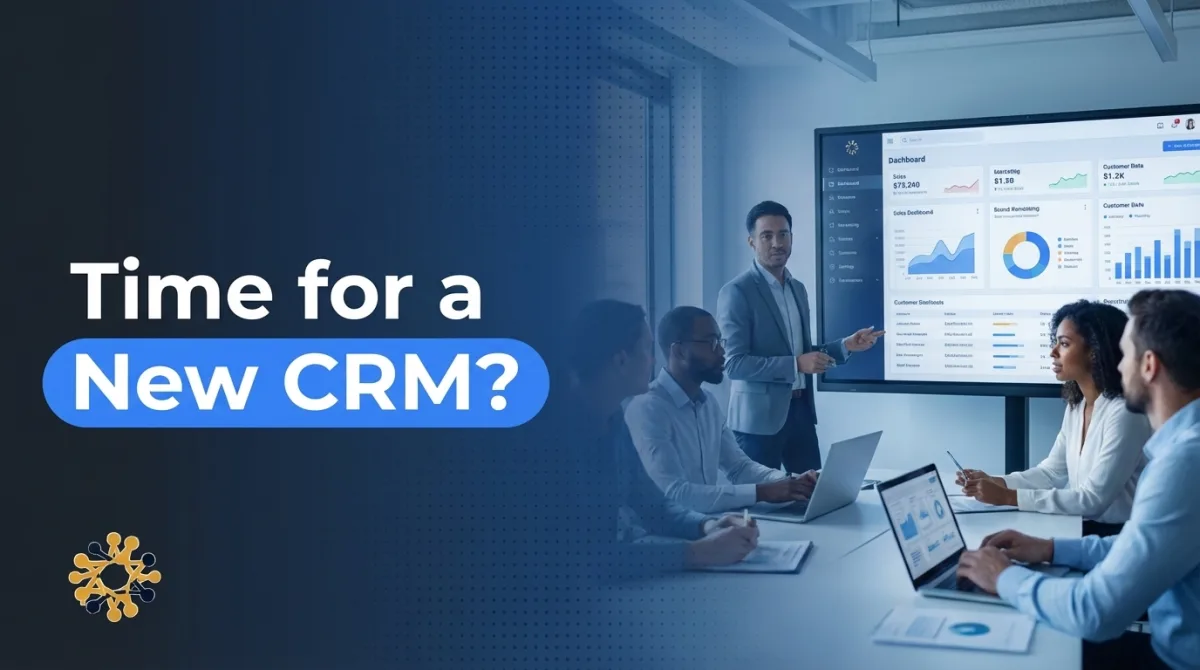
Is your CRM making it harder to find customer details, follow up on enquiries or keep deals moving? Review the following signs against your own team’s experience before deciding whether to replace it.
A robust CRM is the backbone of modern business, centralizing customer data, automating key processes, and fostering stronger relationships. When your CRM falls short, it impacts everything from lead generation to customer retention. Let's explore the critical signs that signal it's time to evaluate a new CRM solution.
Are You Drowning in Disconnected Data?
If your team spends more time hunting for customer information across disparate spreadsheets, emails, and notes than actually engaging with clients, then data silos are likely a major issue. A fragmented view of your customers leads to missed opportunities and inconsistent service.
A modern CRM system consolidates all customer interactions, purchase history, and communication logs into a single, unified profile. This eliminates data silos, ensuring every team member has immediate access to accurate, up-to-date information, fostering a truly holistic customer experience.
Is Your Sales Team Struggling with Manual Tasks?
When sales representatives are bogged down by repetitive administrative tasks like manual data entry, follow-up scheduling, or report generation, their productivity suffers. This isn't just inefficient; it diverts valuable time away from selling and relationship building.
A new CRM with robust sales force automation and workflow automation capabilities can dramatically streamline these processes. Features such as automated lead assignment, email sequencing, and task reminders free up your sales team to focus on higher-value activities, directly impacting revenue.
Key Takeaway: An outdated CRM forces manual work, costing valuable time. A modern system automates repetitive tasks, empowering your team to focus on strategic growth.
Are You Missing Out on Customer Insights?
Without clear, actionable insights into your customer base, making informed business decisions becomes a guessing game. If your CRM lacks customizable dashboards or comprehensive analytics, you're likely operating without a full understanding of customer behavior, sales performance, or marketing effectiveness.
Modern CRM platforms provide powerful reporting tools and customizable dashboards that offer real-time insights into every aspect of your customer journey and business performance. This allows for data-driven decision-making, helping you identify trends, optimize strategies, and predict future outcomes with greater accuracy.
Is Customer Communication Inconsistent and Inefficient?
If your customer interactions feel disjointed, with clients receiving mixed messages or having to repeat themselves across different channels, your communication strategy is likely suffering. A lack of integrated communication tools within your CRM creates friction for both your team and your customers.
Check that the CRM supports the communication channels your team needs and that records are visible to the right people. In ThriveBase, test each configured channel and a complete handover; consistent communication still depends on the team’s process.
Is Your Current System Difficult to Use and Adopt?
A CRM, no matter how feature-rich, is only effective if your team actually uses it. If your current system has a steep learning curve, a clunky interface, or requires extensive technical knowledge, user adoption will inevitably be low. This renders its potential benefits moot.
Ask the team to test the everyday tasks before choosing a CRM. Check how easily they can find a contact, record an outcome and assign the next step. Include training and configuration in the rollout plan.
Are Your Costs Escalating with Multiple Software Subscriptions?
Juggling multiple disconnected tools for CRM, sales, marketing, and project management can lead to surprisingly high cumulative costs. Each separate subscription adds up, not just in monetary terms, but also in the time and effort required for integration and maintenance.
An all-in-one business management platform can replace numerous individual tools, offering a single, cost-effective solution. This consolidation not only saves money but also eliminates integration headaches and simplifies your tech stack.
Is Your CRM Unable to Scale with Your Growth?
As your business expands, your CRM needs to grow with you. If your current system struggles to handle increasing volumes of data, more users, or complex workflows, it's a clear sign it's holding you back. A lack of scalability can lead to performance issues and hinder your ability to adapt.
A new CRM should offer flexible pricing plans and robust infrastructure that can seamlessly accommodate growth, from small teams to larger organizations. This ensures your operations remain efficient and your customer data manageable, no matter how quickly your business evolves.
Are You Lacking Modern AI and Automation Capabilities?
In 2026, AI and machine learning are no longer luxuries but necessities for competitive CRM. If your system lacks AI-powered chatbots, predictive analytics, or intelligent automation, you're missing out on significant opportunities to enhance customer interactions and operational efficiency.
AI-assisted transcripts and drafts may help with reviewing calls and preparing follow-ups. Test accuracy with your own examples, verify important details and keep a person responsible for the final response.
Is Mobile Access a Constant Challenge for Your Team?
In today's global, on-the-go business environment, the ability to manage operations from anywhere is crucial. If your CRM offers limited or clunky mobile access, your sales team, field service personnel, or even managers are at a disadvantage when away from their desks.
A new CRM should provide seamless mobile access, allowing your team to update contacts, check schedules, manage leads, and communicate with customers from their smartphones or tablets. This flexibility ensures productivity doesn't drop when your team is out of the office.
Are You Unable to Customize Your CRM to Your Business Needs?
Every business is unique, with specific workflows and requirements. If your current CRM offers rigid, one-size-fits-all templates and limited customization options, it forces you to adapt your processes to the software, rather than the other way around. This can be incredibly frustrating and inefficient.
A truly effective CRM provides extensive customization options, from dashboards and reports to workflows and forms. This configurability ensures the platform aligns perfectly with your specific operational needs and industry nuances, enhancing relevance and usability for your team.
Old CRM Challenges | Modern CRM Benefits |
|---|---|
Data scattered across multiple systems | Centralized, unified customer data |
Manual, repetitive administrative tasks | Extensive workflow and sales automation |
Limited insights and basic reporting | AI-powered analytics and customizable dashboards |
Inconsistent customer communication | Integrated omnichannel communication (email, SMS, calling) |
High costs from multiple software subscriptions | Cost-effective, all-in-one platform |
If these signs resonate with your current business situation, it's a strong indicator that your existing CRM is no longer serving your strategic goals. Evaluating a new solution isn't just about replacing old software; it's about investing in a platform that can simplify operations, automate tasks, and ultimately help your business thrive in a competitive global market.
What's the Bottom Line?
Data Centralization is Key: Disconnected data is a major red flag, signaling a need for a unified platform that provides a 360-degree view of your customers.
Automation Drives Efficiency: If manual tasks bog down your team, a new CRM with robust automation can free up valuable time for growth-focused activities.
Insights Fuel Growth: Modern CRMs offer advanced analytics and customizable dashboards for data-driven decision-making, crucial for understanding and predicting market trends.
Scalability and Customization Matter: Your CRM should adapt to your business's unique needs and growth trajectory, not the other way around, ensuring long-term relevance and effectiveness.
Embrace Modern Technology: Leverage AI and integrated communication tools to stay competitive, enhance customer experiences, and streamline operations in today's digital landscape.
Frequently Asked Questions
How quickly can I get started with a new CRM like ThriveBase?
Allow time to clean contacts, map fields, configure channels and train the team. A small pilot gives you a practical estimate of the migration effort.
Do I need technical skills for modern CRM platforms?
Test the everyday tasks with the people who will use the CRM. Simple contact and pipeline work should be understandable without coding, while integrations or advanced configuration may need help.
Can a new CRM really save money?
Absolutely. By consolidating multiple tools into one integrated platform, a new CRM can significantly reduce your overall software expenditure. Beyond direct cost savings, the increased efficiency, improved productivity, and enhanced customer satisfaction contribute to substantial long-term financial benefits and ROI.